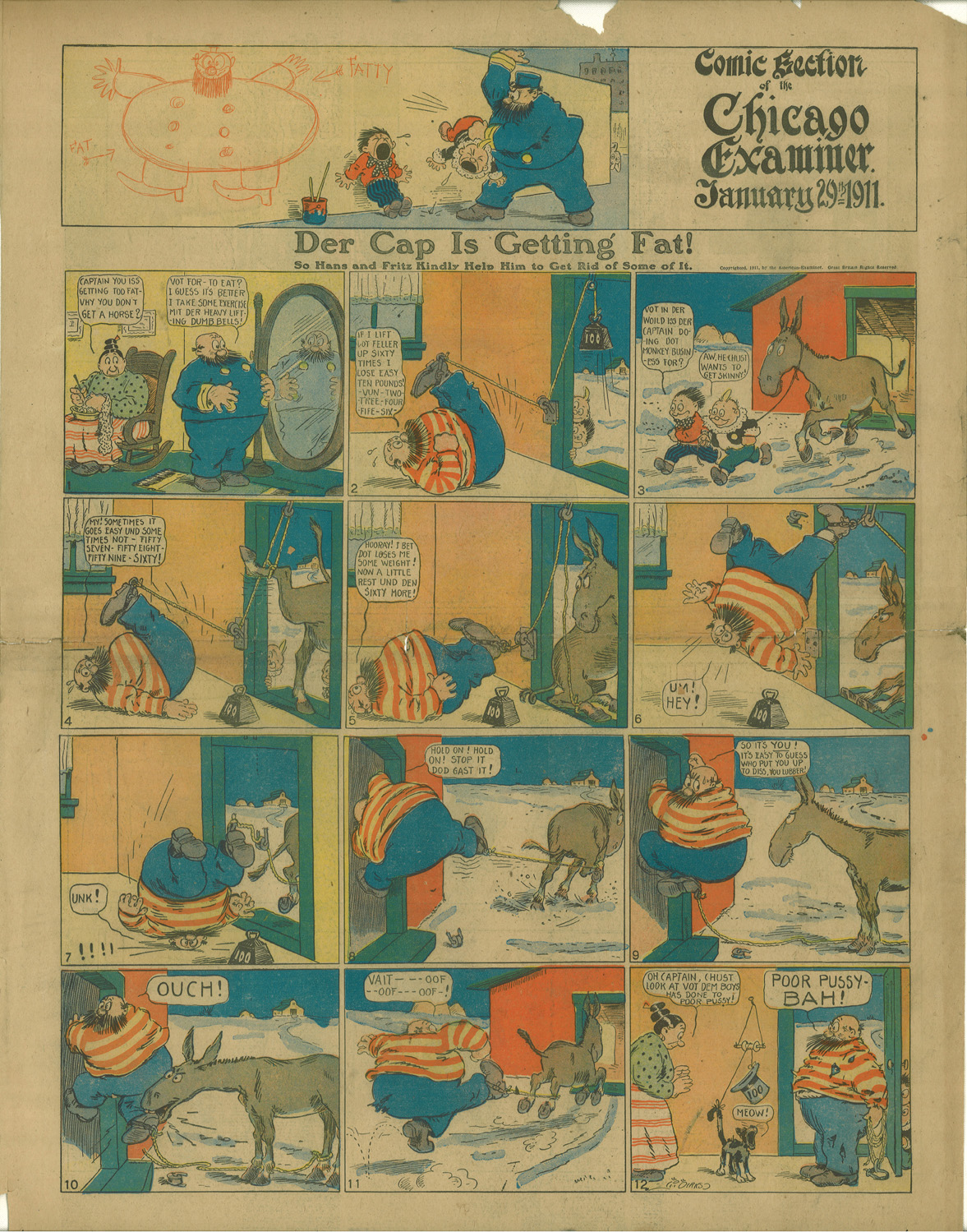
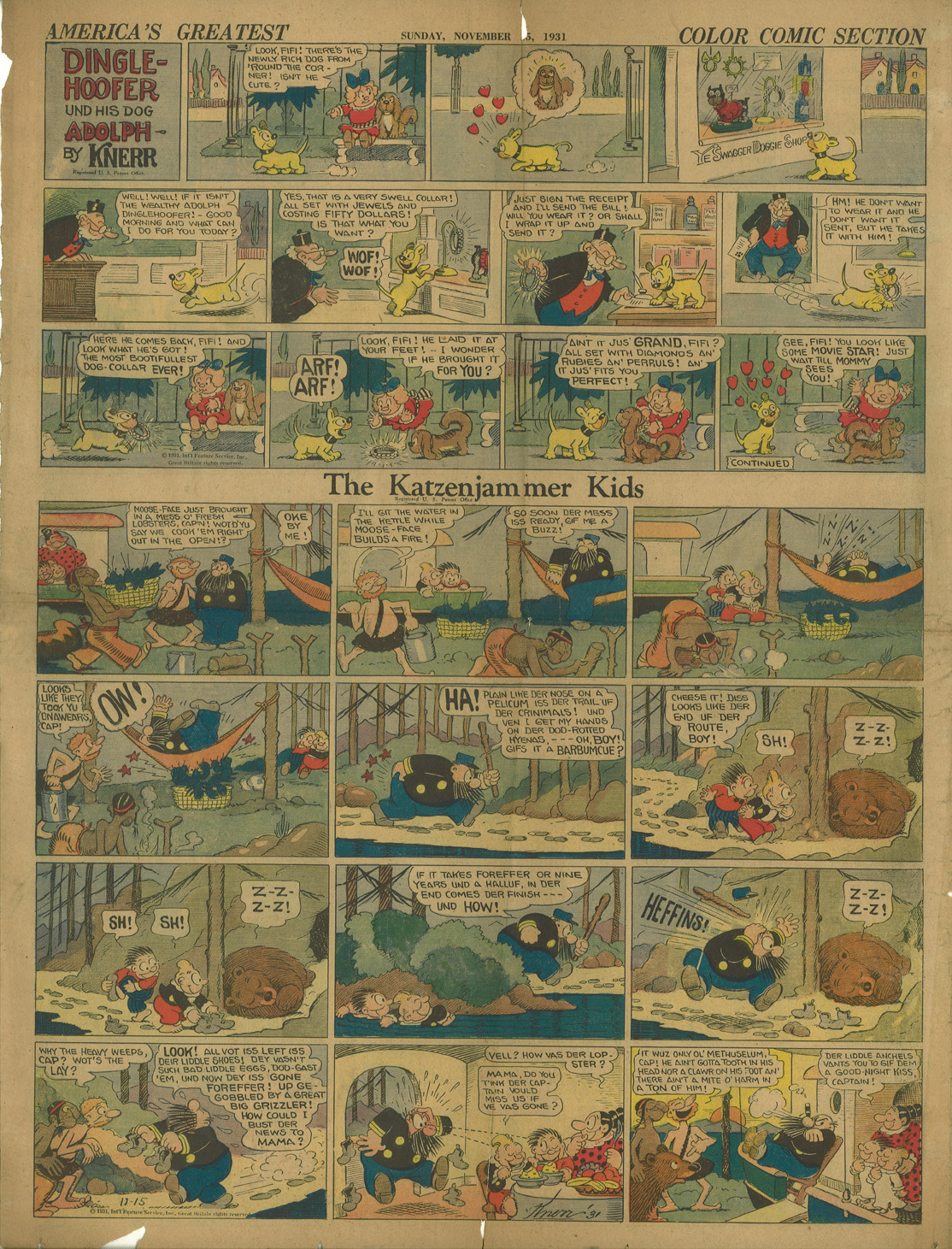
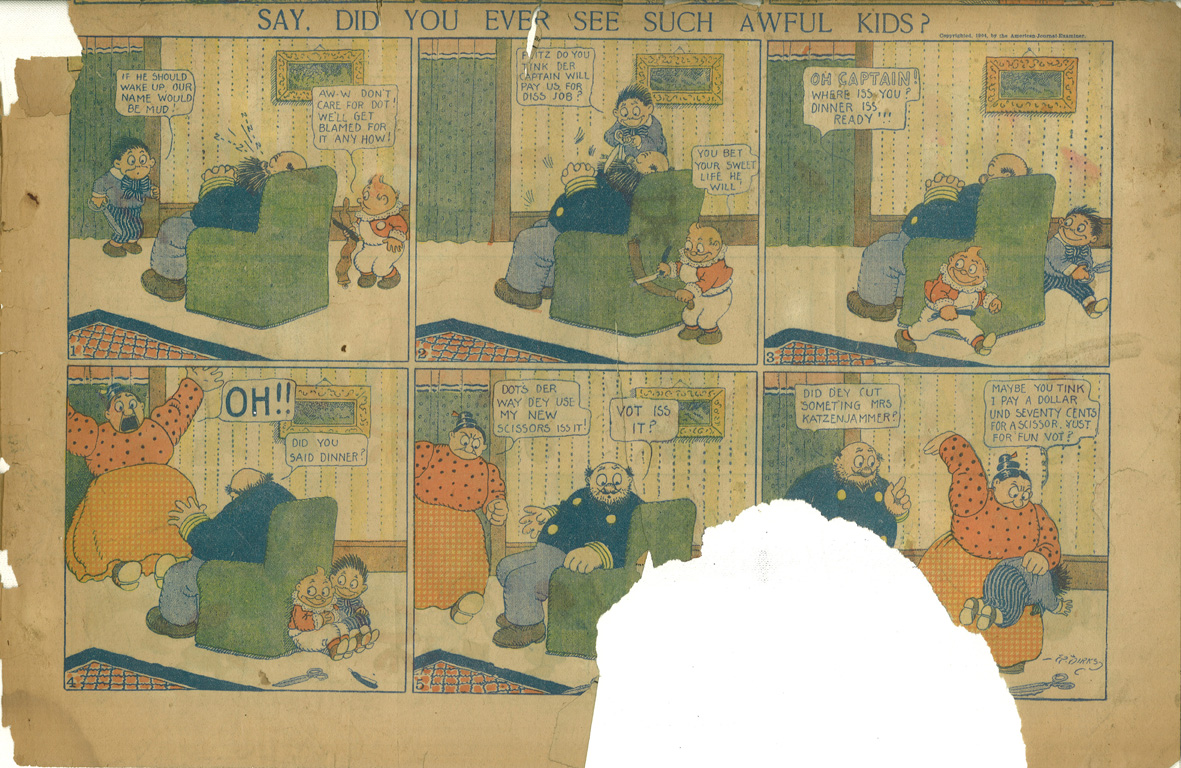
Here’s a Harold Knerr Katzenjammer Kids strip I scanned from 1931. Knerr took over the strip after Rudolph Dirks quit Hearst and went on to do the same strip, different title as Hans und Fritz and then The Captain and the Kids for another paper. You can read the details on Wikipedia here. The scan also includes the Knerr header strip Dinglehoofer and His Dog Adolph.
Please note that this strip contains offensive racial depictions, as was frequently the case with the comics of yesteryear. If this sort of thing offends you, I suggest you do not read it.
I was curious to find some Charles Mintz cartoons, as I haven’t seen many of them. There aren’t a whole lot of them out there on the internets yet… he produced this one for Columbia, and it is directed by Art Davis. Mintz is probably best known these days for screwing Walt Disney out of the character Oswald the Lucky Rabbit. This beautifully animated cartoon starts slow, but boy does it get twisted. Alcoholism, child abduction and endangerment, gunfire, racism… yep, they don’t make ’em like this any more. If you are easily offended, you may not want to watch this one.
Click the above image to see the full-size image on the site I found it on.
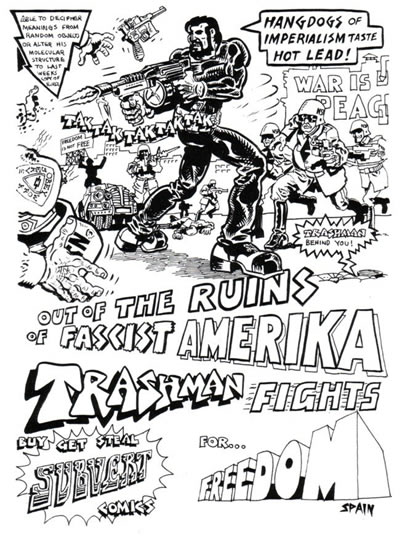
Spain Rodriguez got his start as one of the Zap crew of underground cartoonists in the late 60’s. Spain’s Trashman and Big Bitch are a lot of fun, but he really shines in his wild autobiographical strips. Spain has lived a very interesting life, and his true life stories are full of humor, violence and mayhem. Many of his autobiographical strips have been collected in his book My True Story… his autobiographical strips also appear regularly in the excellent anthology Blab! His historical strips (many of which are also included in My True Story) are quite wonderful as well. His art is made for black and white, and graphic in every sense of the word… something like a cross between EC Comics, old Russian poster art, Jack Kirby, and cheap beer.
Betty Boop’s character was actually based by animator Grim Natwick on vaudeville performer Helen Kane. Miss Kane wasn’t pleased… here’s what Wikipedia says about it…
In 1930, Fleischer Studios animator Grim Natwick introduced a caricature of Helen Kane, with droopy dog ears and a squeaky singing voice, in the Talkartoons cartoon Dizzy Dishes. “Betty Boop”, as the character was later dubbed, soon became popular and the star of her own cartoons. In 1932, she was changed into a human from a dog, her long ears turning into hoop earrings.
In 1932, Kane filed an unsuccessful $250,000 suit against Paramount and Max Fleischer, charging unfair competition and wrongful appropriation in the Betty Boop cartoons. The trial opened in April 1934 with Helen Kane and Betty Boop films being screened by Judge McGoldrick (no jury was called). Margy Hines, Bonnie Poe, and, most notably, Betty Boop voice-over talent Mae Questel, were all summoned to testify. McGoldrick ruled against Kane in 1934, claiming that Kane’s testimony could not prove that her singing style was unique or not an imitation itself (a little-known black singer known as “Baby Esther” was cited by the defence as “booping” in song).
Surprisingly, there are a lot of Helen Kane videos on the web… here are a few of them.
Here’s Helen Kane in “Dangerous Nan McGrew” (the name being a take off of the Robert Service poem The Shooting of Dan McGrew)
Here she is performing “I Love Myself Because You Love Me”
Here she is performing “He’s So Unusual” and “The Prep Step”
I can’t find any films or recordings of “Baby Esther,” unfortunately… it sounds like she may have been the original original Boop-A-Doop girl.