Crumbling Paper: Proto-Kats

As I’ve mentioned previously, my favorite cartoonist of all time is George Herriman, best known for the wonderful comic strip Krazy Kat (which thankfully been the subject of a lot of wonderful reprint books).

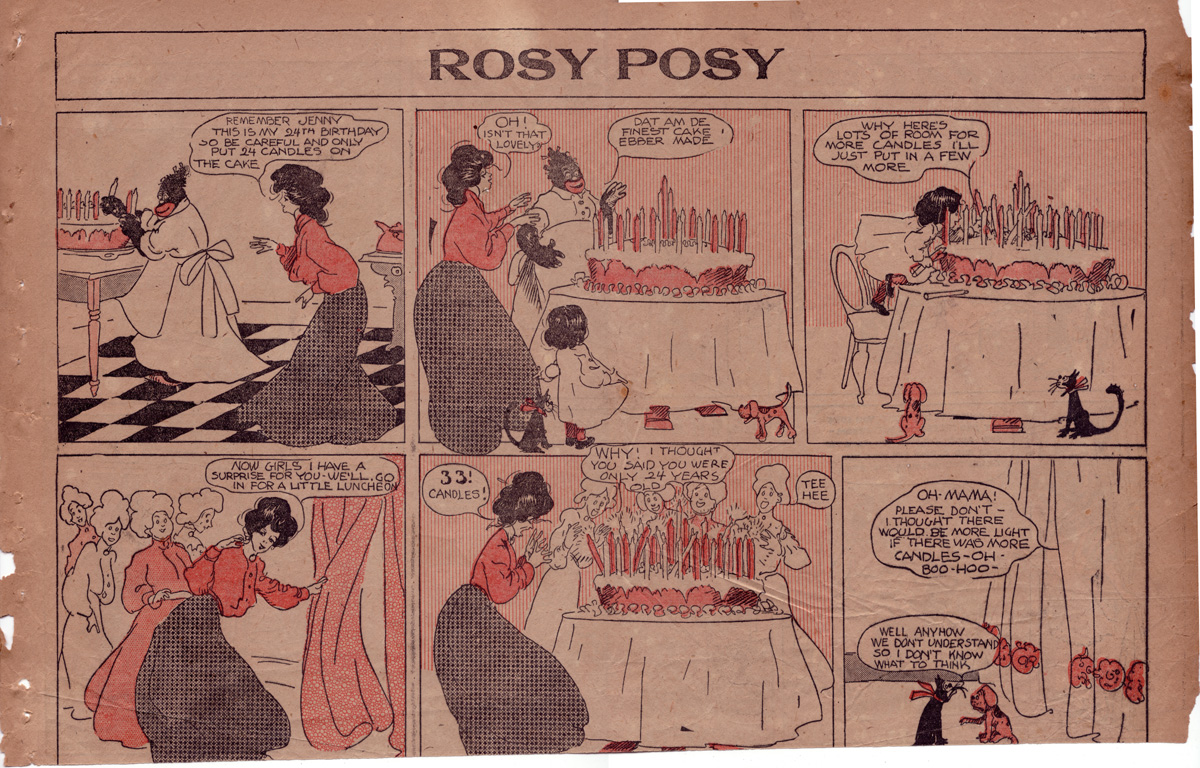
I was excited recently to purchase an old Sunday comic strip that includes what could be an early example of the Kat. It wouldn’t be the earliest proto-Kat… according to The Komplete Kat Komics Volume 1, that would be in Herriman’s 1903 strip Lariat Pete.

It’s an early (1906) strip from a largely forgotten Herriman series called Rosy Posy, a comic strip about a precocious little girl in the Buster Brown mold. This example of it includes a proto-Kat, red bow and all, who even has something to say in the last panel. You can view the entire strip by clicking the link… note that if racial caricatures offend you, you may not want to view it, as it includes a very stereotypical depiction of a black servant circa 1906.

That all said, this strip isn’t signed (or the signature has crumbled off), and although Rosy Posy is a Herriman strip according to the San Francisco Academy of Comic Art collection, I really don’t think he drew this one. It doesn’t look at all like his style to me… it is much stiffer than the other Herriman strips I’ve seen from that period, and the characters look different than in the other examples I’ve seen. Heck, Rosy’s a brunette here, and a blonde in the other examples.

There is a Rosy Posy reference image in the San Francisco Academy of Comic Art collection that can be viewed here. You can see another 3 panel example of Rosy Posy (complete with another Kat example) on the Coconino County strip gallery here… however that example was also reprinted in The Komplete Kat Komics Volume 1, and this version is missing the last 3 panels.

There were a couple other strips of interest I purchased at the same time as the above. Here is a strip called Mrs. Timekiller by L.A. Searl. Note that there is a familiar Kat in the first panel of this strip as well!

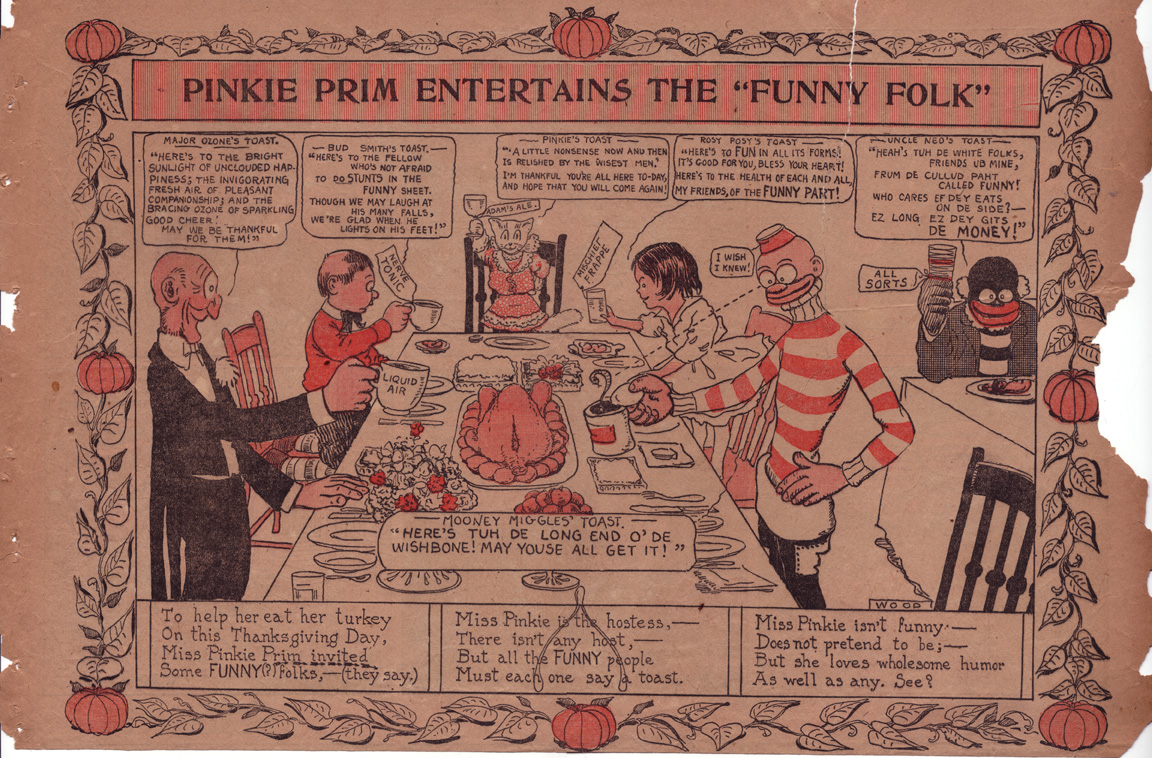
Finally, (on the back of Mrs. Timekiller) here’s a delightful Thanksgiving-themed strip called Pinkie Prim Entertains ‘the Funny Folk,’ which, although not drawn by Herriman, contains three of his characters, Rosy Posy (again, a brunette), Major Ozone and Bud Smith. Also included in the festivities are Mooney Miggles, Uncle Ned (another tasteless racial depiction, so avoid viewing this if this sort of thing offends you), and of course, Pinkie Prim. This strip is drawn by the unfortunately-named Dick Wood.

Crumbling Paper: Gluyas Williams Circa 1927 Strip #1

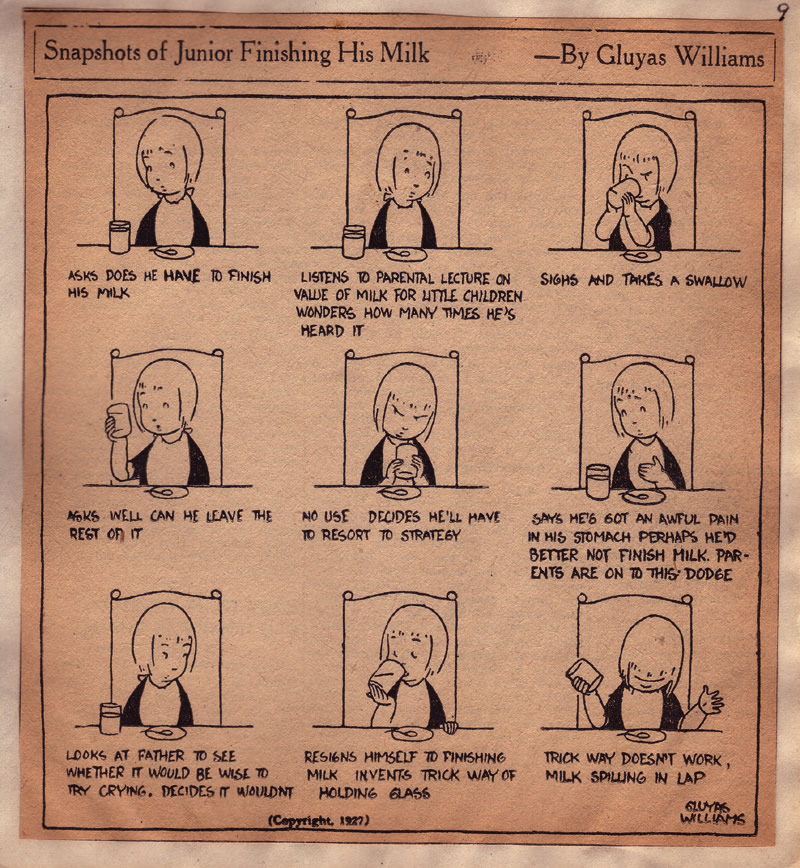
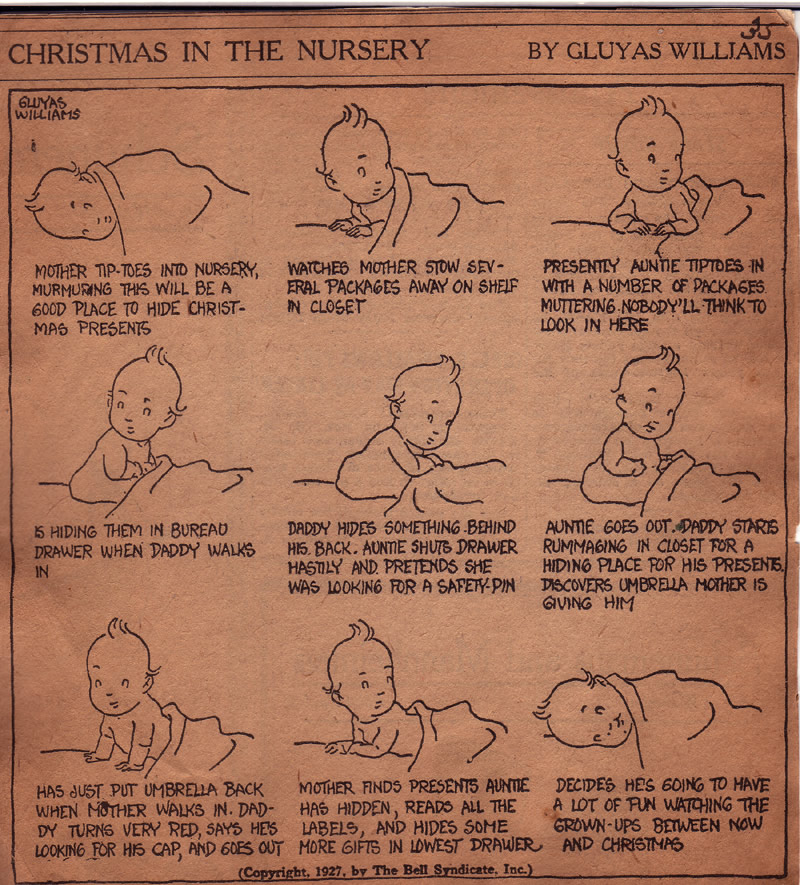
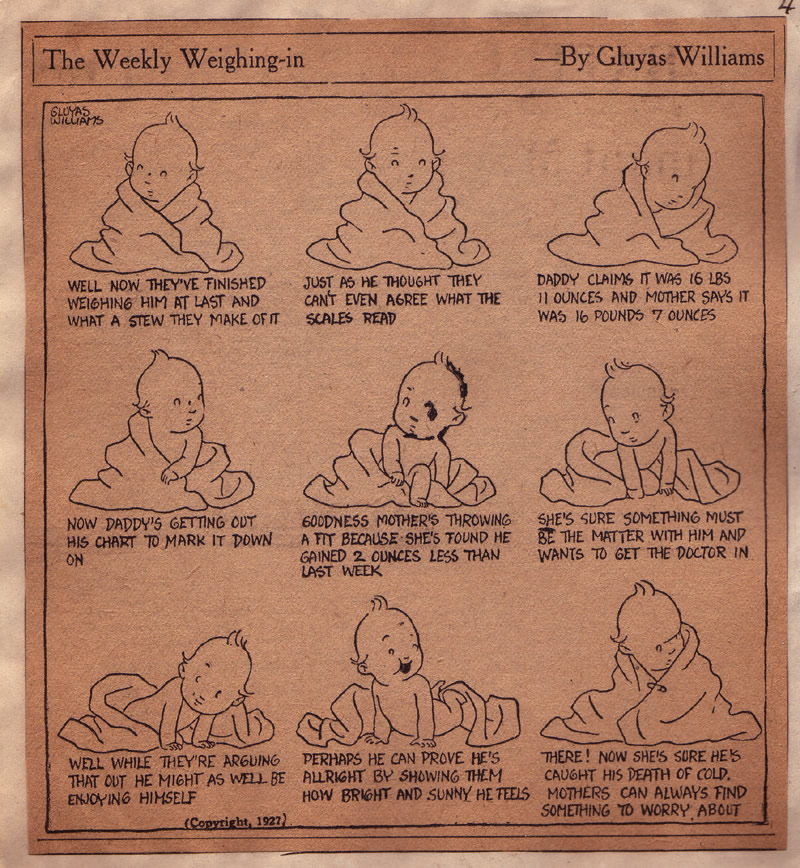
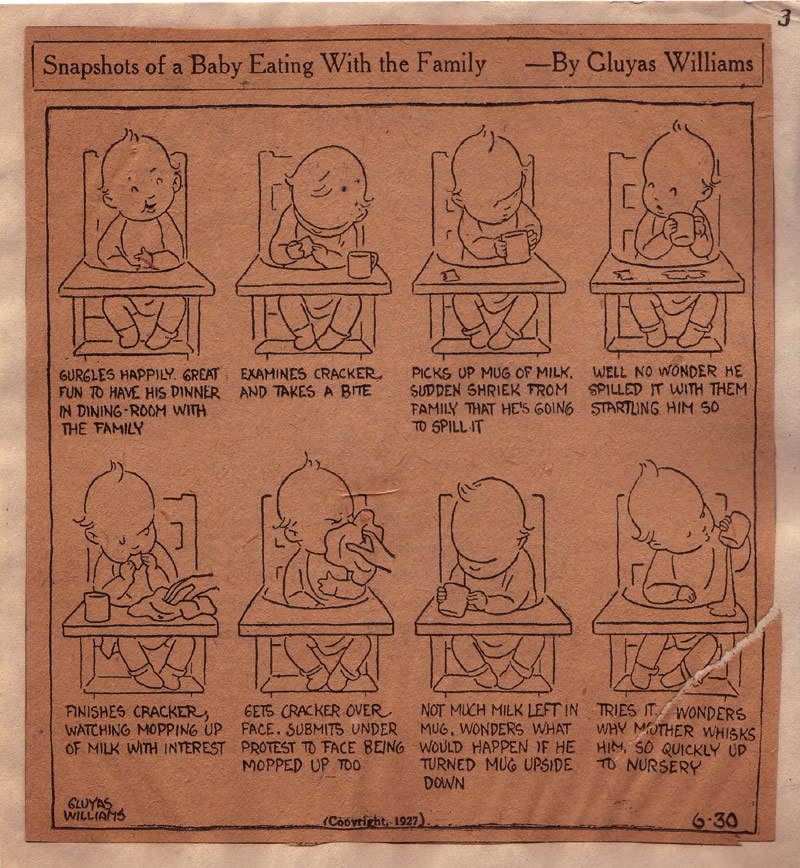
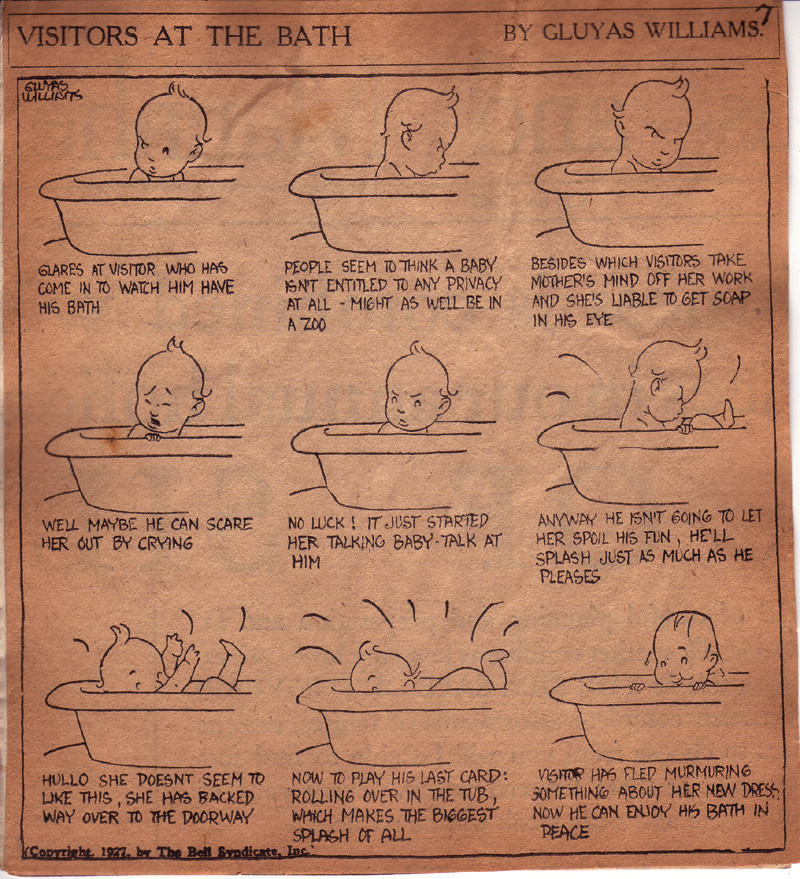
My friend Zander Cannon recently gave me a stack of wonderful old strips by Gluyas Williams that his Grandmother had clipped in 1927. Williams reminds me of Jules Feiffer in both his spare compostions and his keen observation of human foibles… I wonder if he was an influence on Feiffer? Two sites on the web do a lovely job of highlighting the work of Williams: the recently launched gluyaswilliams.com, and, of course, the amazing Barnacle Press. I’m going to be reprinting the strips that I have here over the next months. Here’s the first one… click on the image to see the full strip.

Classic Comics in Print: A Tour of the Gold Mine

Although finding classic comics on the web is great, printed comics are more pleasing to read than ones read on a computer monitor, in my view. Good reprints of classic comics used to be relatively hard to come by… we now live in a world filled with many reprints of the greatest work from comics history… it is truly an embarrassment of riches (although there is still, of course, huge amounts of beautiful neglected stuff… I’ll talk about that in future posts).

This article will provide an overview of some of the great reprinted material that is out there, in no particular order.
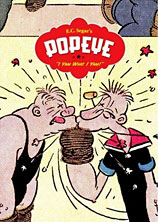
Cover to E.C. Segar's Popeye Volume 1

1) Fantagraphics Books (fantagraphics.com) is indeed the world’s greatest publisher of comics, and they offer a huge selection of amazing reprints among their wares (along with some of the best new stuff you’ll find anywhere). They are currently reprinting some of the greatest comics of all time, and doing it with style, class, historical research, and good design (which is not true of many of the other comics reprint publishers).

Here you can find (in progress) the complete George Herriman Krazy Kat Sundays (and a dailies overview book coming soon, all beautifully designed by Chris Ware… the Sunday books will also be including Herriman’s Stumble Inn Sundays), the complete Charles Schulz Peanuts, the complete Elzie Segar Popeye (a new series just started… they reprinted these previously in excellent but inferior black and white volumes), the complete Walt Kelly Pogo (new series coming soon), the complete Walt Kelly Our Gang, a volume of Otto Messmer’s Felix the Cat, the complete Harold Gray Little Orphan Annie (new series coming soon), the complete Hal Foster Prince Valiant, the complete Hank Ketcham Dennis the Menace, some great Winsor McCay reprints, the collected works of Jules Feiffer, a new printing of The Comic Strip Art of Lyonel Feininger (coming soon) and more.

In addition to all the great old strip reprints and great modern stuff, they have also produced a number of reprints of some of the best in underground and more recent comics, including The Complete Crumb, Foolbert Sturgeon’s The New Adventures of Jesus, some Jack Jackson reprints, and a ton of Vaughn Bode stuff.

Besides all of those wonders, they publish the Comics Journal, which now includes a healthy chunk of comics in every issue, generally reprinted from obscure sources.

Please note that Fantagraphics is currently suffering very serious and expensive legal troubles, and they have started a legal defense fund to help with this. One of the best ways you can assist them is to BUY THEIR BOOKS, preferably directly from them. A good cause like this is a great way to help justify doing yourself the favor of purchasing some their vast array of wonderful books.

2) Drawn and Quarterly (drawnandquarterly.com), another wonderful publisher of comics, is currently publishing beautifully designed reprints of Frank King’s Gasoline Alley (published as Walt and Skeezix) and Tove Jansson’s Moomin. Their Yoshihiro Tatsumi reprints have been very interesting… Tatsumi was (and presumably still is) quite the innovator in presenting adult content in comics, and I had never seen any of his work before these reprints. They have a Clare Briggs’ Oh Skin-nay! reprint in the works as well.
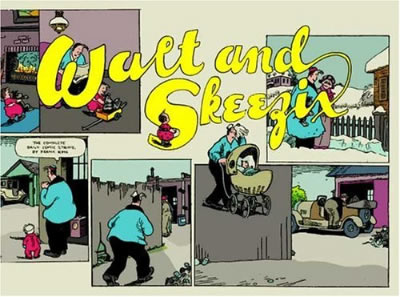
Cover to Walt and Skeezix Volume 1

3) Spec Productions (specproductions.com) produces many small press reprints of obscure and wonderful stuff, with an emphasis on old adventure strips including Captain Easy, Flash Gordon, Buck Rogers, Alley Oop… and Gasoline Alley!

Besides adventure strips, they are producing some great George Herriman reprints called By George! The Komplete Daily Komics of George Herriman edited by comics historian Bill Blackbeard (full disclosure: I designed the covers for volumes 2-4). These books reprint much Herriman stuff you won’t find anywhere else, including the first Krazy Kat strips!
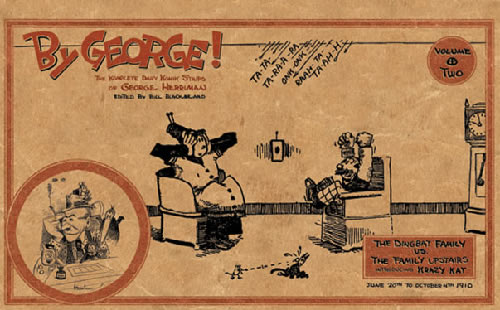
Cover to By George Volume 2

Krazy Kat got her start as a footer strip for Herriman’s comic strip The Dingbat Family (aka The Family Upstairs)… this series aims to reprint that entire series, along with all Herriman’s other dailies (the first volume includes the entire runs of Herriman’s daily strips Baron Mooch and Gooseberry Sprig!).

Also cool about these Herriman reprints, these strips are reprinted at the full size they appeared in the newspaper, which is BIG. You’ll probably want this on the same shelf as your Complete Segar Popeye series from Fantagraphics!

Note that they are also selling A Supplement to The Yellow Kid which is presumably a supplement to the currently out of print (although still relatively inexpensive) R.F. Outcault’s the Yellow Kid: A Centennial Celebration of the Kid Who Started the Comics.

4) The Pacific Comics Club (pacificcomics.com) also offers a variety of small press reprints of stuff that you won’t find elsewhere.

They also have a series of Herriman books, these ones reprinting Herriman’s Krazy Kat dailies (full disclosure: George Herriman is probably my favorite cartoonist of all time). Wonderful stuff… unfortunately, the Krazy Kat strips are reprinted at a very small size… they are well worth owning regardless, seeing as you can’t currently get them anywhere else.
Cover to Pacific's Krazy Kat Dailies 1923

Pacific is also carrying the gorgeous and long out-of-print 2 volume set of Cliff Sterrett’s Polly and Her Pals reprints that came out from Remco in the 80’s… don’t miss these. Sterrett is a master… Polly and Her Pals is expressionistic, beautiful and hilarious… it is one of the greatest comic strips of all time. The cheapest used copy they have on Amazon is over twice the price.

5) Sunday Press Books (sundaypressbooks.com) recently produced an enormous book of Winsor McCay’s Little Nemo in Slumberland, published at the actual size the original strips appeared (16×21 inches).
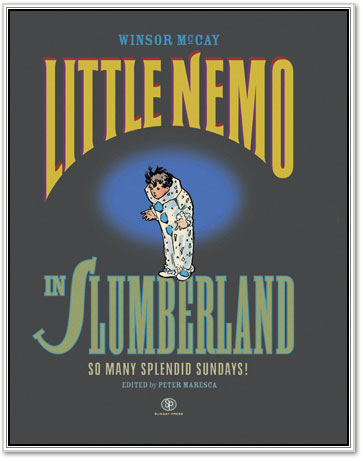
Cover to Sunday Press Books' Little Nemo

I haven’t seen the book, but it has received rave reviews all over the place… apparently, the strips look better than they ever have before (including than they did in the newspaper 100 years ago). They are planning a second volume. They are also planning a collection of McCay’s Little Sammy Sneeze.

Besides the McCay reprints, they are planning additional projects in this enormous format include a reprint of Gasoline Alley Sundays called Sundays With Walt and Skeezix designed by Chris Ware, and a 7 or 8 volume collection of miscellaneous old newspaper comics… I gotta start saving my pennies… read more here.

6) Checker Books (checkerbpg.com) I’ve been buying their comprehensive reprinting of Winsor McCay’s Early Works (8 volumes so far), and it looks like they are adding an oversized Little Nemo reprint, an oversized Dream of the Rarebit Fiend Saturdays reprint, and an oversized book of some of Winsor McCay’s Editorial Works.

Even more exciting (to me) they are starting a series of books reprinting miscellaneous Dr. Seuss editorial cartoons and illustration work. They also are reprinting Flash Gordon, Steve Canyon and Dick Tracy (the Max Collins stuff rather than the Chester Gould).
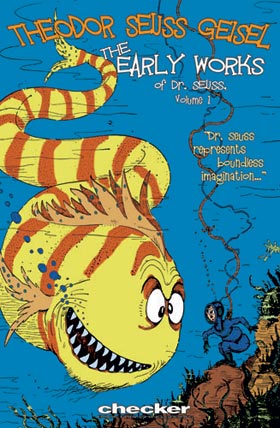
Cover to Checker's Theodor Seuss Geisel: The Early Works Volume 1

7) IDW Publishing (idwpublishing.com) recently started publishing a complete set Chester Gould’s bizarre and stylized Dick Tracy.
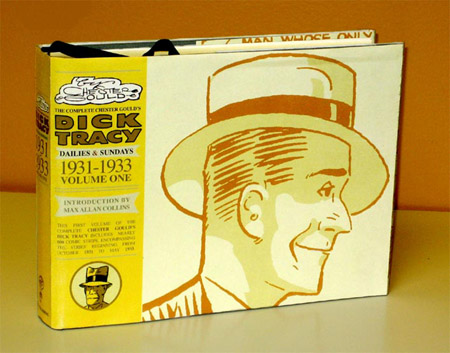
Cover to IDW Publishing's reprint of Chester Gould's Dick Tracy Volume 1

8) Lee Valley (leevalley.com) Here’s a weird one. Lee Valley offers reprints of Out Our Way, Our Boarding house with Major Hoople, and The Bull of the Woods, as well as cowboy and US Calvary cartoons… and a whole lotta books on woodworking. Go figure.

Cover to Lee Valley's reprint of Out Our Way

9) NBM Books (nbmpub.com), an excellent comics publisher probably known mostly for their reprints of modern European comics (they’ve reprinted some great Lewis Trondheim, Joann Sfar and Jacques Tardi books… and they are the major publisher of underrated American cartooning genius Rick Geary) appears to be getting into the comic strip reprinting game… they have a reprint of Mutt and Jeff (the first daily comic strip) listed on Amazon. Here’s an article about the reprint (the strip was originally titled A. Mutt).
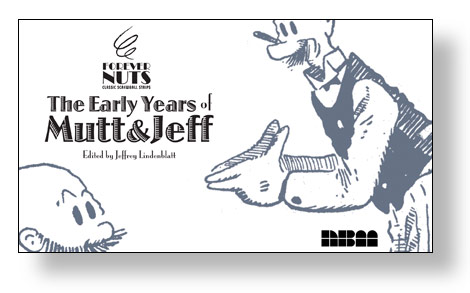
Cover to NBM's Forever Nuts: The Early Years of Mutt and Jeff

Digressing, here’s an interesting bit of comics history about Mutt and Jeff. The Mutt and Jeff comic started in the sports section of newspapers, and part of the reason it became hugely popular (besides the fact that it was really funny) was that apparently some people thought you could get tips on what racehorses were destined to win from the strip.

10) Hogan’s Alley magazine regularly reprints a chunk of classic comics that you won’t see anywhere else. It is the closest thing out there right now to the sorely missed Nemo Magazine published long ago by Fantagraphics, which had a wealth of comics history in it (you can still hunt down back issues of Nemo pretty cheap on Ebay).
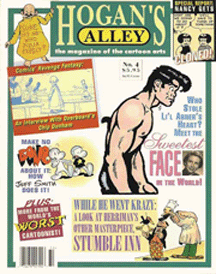
Cover to an issue of Hogan's Alley

11) DC Comics (dccomics.com) has a series called DC Archives that reprints mostly various Time-Warner-owned properties. Some highlights of this (in my view) are Will Eisner’s excellent series The Spirit (which is actually not a Time-Warner property, as far as I know), Mad (only one volume so far, alas), Plastic Man, and Captain Marvel (Shazam!). Lots of good obvious stuff too, like Superman and Batman. I wish they’d reprint Fox and Crow!
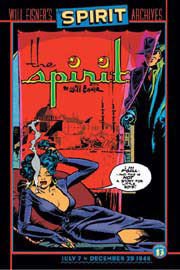
Cover to a volume of the Will Eisner The Spirit reprint series

Unfortunately, these books are awfully expensive… around 50 bucks each, depending on the volume. They really need to put these out in paperbacks.

Note that although they have only reprinted one issue of Mad as a book, they just released every issue of mad on a DVD set.

On the subject of complete magazines on DVD, you can get the Complete Cartoons of the New Yorker this way as well, or the Complete New Yorker if you want to get more than just the comics. I heard somewhere recently they were going to put out the complete Playboy magazines & cartoons this way as well.

12) Marvel Comics (marvel.com) has two reprint series of their stuff… their Marvel Masterworks series and their Essentials series. The Essentials series is no frills, black and white, phonebook-like, and cheap. The Masterworks series is color, slick, and mostly hardcover and overpriced like the DC Archives. However, they recently reprinted some paperback Masterworks volumes with Barnes and Noble that are VERY cheap… especially when you find them on the discount shelves at Barnes and Noble. Highlights of this stuff (in my view) would be the Ditko/Lee Spiderman, the Kirby/Lee Fantastic Four and the Steve Gerber Howard the Duck (only available as an Essentials volume).
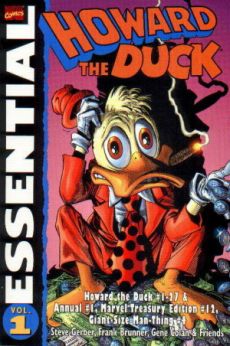
Cover to the Essentials Howard the Duck reprint

It is worth noting, that, although the paper of the essentials volumes is cheap and will probably deteriorate rapidly over time, a lot of this stuff looks better to me in black and white than color (a lot of the coloring they are using just looks unpleasantly garish on slick paper).

Marvel has started to explore complete DVD collections of their archives as well… here’s the complete Spider-Man on DVD.

13) Dark Horse Comics (darkhorse.com) is currently doing a great, very affordable reprint series of John Stanley and Irving Tripp’s Little Lulu. They’ve also reprinted some great old Japanese comics, including Osamu Tezuka’s Astro Boy and Kazuo Koike’s Lone Wolf and Cub. They also published the reprints of Bob Burden’s Flaming Carrot, which, while not that old, is a classic comic in my view.
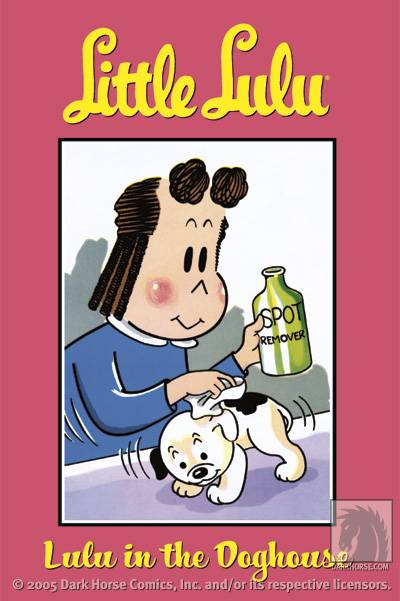
Cover to a volume of Dark Horse's Little Lulu reprint series

14) Russ Cochran, who has done a number of wonderful reprints of the output of EC Comics in the past has started a new series of full-color hardcover reprints of them. He’s starting this series with reprints of Weird Science and Shock SupenStories.
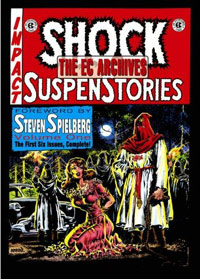
Cover to a volume of Russ Cochran's Shock Supenstories reprint series

15) American Comic Archive (americancomicarchive.com) is publishing a magazine called Big Fun, which reprints some classic adventure comics including the Leslie Turner Captain Easy.
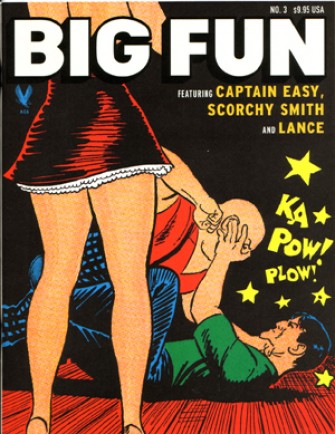
Cover to an issue of American Comic Archives' Big Fun Magazine

16) Rick Norwood’s Manuscript Press is the publisher of long-running strip reprint magazine Comics Revue.
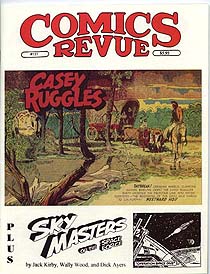
Cover to an issue of Manuscript Press' Comics Revue Magazine

If you are planning to buy some of these books (and aren’t planning on doing it directly from the publishers), you should really check out Bud Plant, as they have the world’s most mouth-watering catalog of wonderful comics-related and other art books, many at insane discount off of the cover price, and for every $100 you spend they give you $10 off your next order. They also have a lot of signed books with special bookplates that you can get nowhere else… and generally these bonuses cost no more than the regular price of the books. They carry the majority of the stuff mentioned in this article, as well as a number of great reprint books that are long out of print, like volumes of the Kitchen Sink Press reprints of Al Capp’s Li’l Abner.

Another resource is Ken Pierce Books (kenpiercebooks.com), which offers a number of strip reprints for sale… I don’t believe they published any of them, but they may have. Again, Bud Plant I think is probably the best resource for getting a bunch of this stuff in one place, but this site may have some stuff that Bud Plant doesn’t.

Isn’t Amazon really making enough money off of all of us as it is? Please consider supporting your local comic book stores as well whenever you make comics-related purchases… if you don’t support them, they disappear.

That said, I haven’t seen this Krazy Kat dailies 1918-1919 reprint (published by Stinging Monkey Press, now defunct) available anywhere recently except for Amazon. I can’t get enough Kat, as you may have noticed… so I’ll also mention that there is a wonderful Krazy Kat: The Comic Art of George Herriman book which provides a great overview of Herriman published by Abrams and co-edited by Patrick McDonnell (author of the best comic strip in today’s papers, Mutts).

Want to read these books and can’t afford them? I can relate! Thank heavens for the public library. Did you know if you request books and other materials from your local public library, they will often buy them? My public library even has a form on their website for such requests. It’s likely your library does also.

Request the comics you want to read at your local library and you do all of the patrons of that library a favor by spreading the good comics love. Although it has improved greatly in recent years, most libraries do not have nearly the comics collections that they should… help them find the good stuff!

I’m sure there are some good reprint projects I haven’t heard about… know of any? Let us hear about them in the comments!

UPDATE: Dirk Deppey of The Comics Journal and the excellent ¡Journalista! blog pointed out another reprint publisher on the Comics Journal Message board… here it is:

17) Classic Comics Press (classiccomicspress.com) is currently publishing reprint books of Leonard Starr’s Mary Perkins On Stage and Gus Edson and Irwin Hasen’s Dondi. I’m not particularly familiar with either strip, but the examples of Dondi I’ve seen seemed pretty good. On Stage has a lot of rave reviews here, including one from the aforementioned Mr. Deppey.

Thanks for the heads up Dirk!

UPDATE #2: I thought of another one I forgot…

18) Pure Imagination has offered reprints of works by Basil Wolverton, Jack Cole, Jack Kirby, Steve Ditko, Alex Toth and more. Their Wolverton reprints are quite wonderful… I wish someone would do a complete reprinting of everything Wolverton ever did. If they have a website, I sure can’t find it. You can see a list of some of their output here, and there is a wikipedia entry about them here.

More About RSS Feeds From Popular Webcomics Hosting Sites

In the comments to my second installment of my How to Get Your Comics Online series of articles, there have been some responses about the rss options for some of the popular webcomics hosting providers, so I thought I would note them here:

1) In addition to webcomicsnation.com, DrunkDuck and Comic Genesis both offer rss feeds.

2) Joey Manley of comics hosting provider webcomicsnation.com (and the excellent Talk About Comics blog) notes that webcomicsnation.com does indeed offer the ability for cartoonists to publish their full rss feeds, it just has to be turned on (partial feeds are the default option). He encourages folks to let webcomicsnation.com cartoonists who don’t offer full feeds know that you want them. Sam Henderson and Roger Langridge, I hope you are reading!

The ProBlogger blog just did a survey of their readers to see what reasons people had for unsubscribing from blogs, which you can see here. Note that the third highest reason is incomplete or partial feeds. If you are a web cartoonist who is not offering your comics in your feeds, you are really shooting yourself in the foot… if you aren’t making it easy for your users to view the content in the way they want to view it, they more than likely will not bother to see your content at all.

HOW TO GET YOUR COMICS ONLINE PART THREE: Getting your Images Ready For the Web

You see a lot of poor quality images on various comics sites (including some of the ones on this one!) Here are some things to think about when getting your art ready to present on the web.

BITMAP VERSUS VECTOR

A lot of people don’t know the difference between bitmap and vector image files.

Bitmap files contain color information about every single pixel in an image. Popular bitmap formats are .jpg, .gif, and .png. Adobe Photoshop is a program that primarily works with bitmap art (although they are combining it more with vector art in the newer versions). These images can be scaled downwards.

Vector files contain mathematical coordinates for the points and lines and other information that an image is made out of. The only really popular vector format I know of is .swf (shockwave flash). Adobe Illustrator is a program that works primarily in vector art. Vector art can be scaled upwards or downwards without losing quality.

A BRIEF OVERVIEW OF THE FORMATS

.bmp

These are bitmap files… they have all of the information about every pixel of your image uncompressed. These make good, high quality source files, but you will never want to publish them to the web, as they are large files, and will take too long to download.

.jpg

Probably the most widely used format is the .jpg (it is the format most digital cameras take pictures in). It is good for some things, but not for others. It is a lossy format, and most bitmap editing programs will ask you how high of quality you want to save it as when you save it.

Being a lossy format, the lower the setting you choose on this, the more information you lose… you sacrifice image quality for small image sizes. You lose information in an image even saving a jpg at 100 quality, so never use jpgs for your source files.

Why would you want a lower quality image? File size. If you want an image to download quickly, the .jpg does a nice job of compressing the information. At low settings, though, your images will look muddier and muddier.

The .jpg file tends to work well for gradiated color, photographic, and greyscale images.

.gif

.Gif files are also a lossy format, so again, never use these for your source files. However rather than controlling the range of quality from 1-100 to compress, with gif files you manipulate the color palette embedded in an image. The more you limit the number of colors used in a gif image, the smaller the file gets.

The .gif format works well for black and white and flat color images with a limited color range. Also, gif files can handle alpha transparencies, which jpg files can not.

You can have animated .gif files, but these are very limited. If these are not kept very brief they can get very large very fast.

.png

There are three major web compatible formats for presenting bitmap graphics, .gif, .jpg and .png. Of those, .png is rarely used.

Why is this? I believe mostly because the format was developed later than the other two formats. PNG’s actually use most of the advantages of both .jpgs and .gifs, and improve and expand on them vastly.

I think they are compatible with all browsers too.

That said, I almost never use them except for source files (they are a lossless format)… this is probably more a force of habit on my part than anything else. Since they are a lossless format, they don’t “approximate information” of the source for the sake of compression, as jpgs and gifs do.

You can read more about the advantages of png files here, if you’re interested.

Note that the .png format was adopted as the source file format for Adobe Fireworks, which is an excellent program for preparing bitmap images for the web. It also does a very nice job of integrating vector art, bitmap art and fonts… I’m not sure if it is a default of the file format to handle vector as well as bitmap art or not, but you can do so very well with Fireworks. However, Fireworks is not the robust image editing solution something like Photoshop is (and it isn’t intended to be), but a lot of web-related stuff it handles much better than Photoshop does.

.swf

The .swf is the format popularized by the Adobe Flash Player. Swf files can do a lot of things, including complex full animation and multimedia. It is the only popular vector format used on the web that I’m aware of, although there may be others. There is a little more involved in posting these files online than there is with the other formats. However, since it is vector, you can have totally clean artwork at any dimensions, usually at very small file sizes.

SCANNING

I’m not going to say too much about scanning or image editing in this post… you can read some good information about scanning, among other things, here:

RE: A Guide to Reproduction: A Primer on Xeorgraphy, Silkscreening

I generally scan stuff at 800 DPI as a black and white bitmap for my source copy of a black and white image (if I color, it is generally done on the computer). Save this initial scan as a source file, and make alterations to it as a different file… that way you can always go back to the source if you need to.

Before altering a black and white image in scale or dimension, you’ll want to switch it to greyscale, or you’ll get some ugly, chunky pixels you don’t want.

THINGS TO INCLUDE IN ALL OF YOUR IMAGES

Put copyright information, your name and your website url in all of your images (again, this is something I have neglected on my own website, although I’ve done it a lot in my Soapy the Chicken strip… I should always do this, though!). If you put a circle c © with a date and your name, you should be somewhat legally protected from copyright infringement. Obviously, you want copyright information on your website in general, but you should have it on each individual image you want to own the copyright of as well, because your images may not be viewed only on your website.

Anyone can grab your images for free on the web, and put the images on their website. While ideally they should at least give you credit for an image, frequently they won’t. If this makes you uncomfortable, you should very carefully in considering what you make available on the web. Having your copyright on all of your images will make it so anyone using the image will have to take the significant extra step of editing the image if they want to display your image without you getting copyright credit for it.

While I’m mentioning copyright, you may also want to consider offering some of your work under a creative commons license. These give you more flexibility in defining what can be done with your copyrighted images. The Cartoonist Conspiracy publishes all of the jam comics we produce online using a Attribution-NonCommercial-ShareAlike 2.5 license that allows people to reuse the content from them in certain situations. Read more about creative commons licenses on the creative commons site.

IMAGE SIZE

When deciding what size and dimensions to make your images for the web, consider the nature of the computer monitor. Some people still view the web on computers that only display 800×600 pixels. I tend to think anyone viewing the web at this size is pretty used to scrolling around to find the information they want. However, you may want to generally try to keep your web-posted images under 750 or so pixels wide anyhow to be accommodating… it will keep your file sizes down as well.

If you are making artwork specifically for the web, you may want to consider formatting it horizontally (like a comic strip) rather than vertically (like the traditional vertical comic book page). That way people will be more likely to be able to see the whole strip on their computer monitor at once.

That said, you do have an “infinite canvas,” if you want it… just keep in mind some users may not have patience for a lot of scrolling, if you care. I tend to think most people prefer the traditional & more passive “clicking to the next page” rather than “scrolling to the next part” (which can also take a lot longer to download, since you are loading more images on to a single page).

If you aren’t one of the majority of web users cursed with short attention spans, there have been some wonderful comics done exploring the infinite canvas concept, and it is definitely an area ripe for more exploration.

FILE SIZE

I mention above how some of the formats do a good job of compressing images down to a reasonable file size. File size of your images and all of your files online is an important consideration when you consider both how long it will take your users to download an image and how much of your bandwidth allowance you are going to use up.

That said, small files are somewhat less relevant than they used to be… more and more people have fast connections, and most cartoonists won’t dent their bandwidth allowance if they have a good hosting provider like Dreamhost (although really popular cartoonists might if they have heavily trafficked websites).

I believe having high quality images is more important than having small file sizes… although you don’t want enormous file sizes either. I wouldn’t generally go much below 80% on a jpg you’re publishing, and you probably won’t be happy with most .gif without at least 32 colors in your palette… the amounts on these things will vary with different images depending on how much information they contain, though. Try exporting versions of a graphic at different sizes and compare them… gradually you’ll get a feeling for the quality levels you want to shoot for.

If you’re posting a really large image, just save a small preview “thumbnail” version that links to your main image, or state the file size on the link that leads to the image.

NAMING YOUR FILES

Consider how you name your files carefully before uploading them. First of all, NEVER use uppercase characters, spaces or special characters… these will give you all sorts of headaches. If you feel like you need a space, use an underline _ instead.

I’d recommend trying to use a consistent naming structure for your files so they will be easy to find and know what they are… don’t be afraid of long names! Here’s an example of a good naming structure…

comics_funnycomics_ep01_p001.jpg

This structure breaks down four different components of an image in the name. Comics can be the main subject, funnycomics could be the name of a project, episode01 could indicate that it is the first episode of the comic, and p001 indicates the page number of the image.

Numbering with zeroes at the start of your numbering, as with 001, 002, 003 makes it so you have a consistent number of characters in your names up to page 999. I’ve found this useful in some situations where I know how many digits are going to be in the highest number page or item. It works for me, anyhow.

Use whatever structure works for you and makes sense for the image.

SOFTWARE

I use Adobe Photoshop, Adobe Illustrator, Adobe Fireworks and Adobe Flash for various image editing tasks. These all cost money, unfortunately, and cartoonists don’t generally work with a big budget.

Fortunately, you can probably find free software out there if you look for it. One well-known, widely used free image editing program is GIMP. I’ve never used it, but I’ve heard good things about it.

IMAGE HOSTING AND FTP

OK… you have your images ready to post. What now?

There are a huge number of free image hosting solutions, as I mentioned in the previous chapters of this article… Flickr is a well-known and flexible one, although they require you to have more “photographic” images than drawings or other art (don’t ask me why they have this brain-dead policy, I have no idea). Posting a question about this on the Cartoonist Conspiracy or Comics Journal message boards will probably get you a lot of advice. If you are going to use an image hosting site, MAKE SURE TO READ THEIR LEGALESE before posting anything to confirm that you will retain all rights to your artwork.

Ideally, you have your own web space somewhere you can upload (FTP) files to (FTP stands for “file transfer protocol”). If you have a modern version of windows, you can type the name of the ftp site (like ftp.yoursite.com) into the “address” box of any window and it should bring up a login for the ftp site for you to put your user name and password in. This is nice, because you can then treat the folders on your site pretty much like any other folders on your machine.

If this doesn’t work for you, there are a lot of free FTP programs out there. Filezilla is an excellent one.

Put all of the images on your site in a folder called images. You can add sub-folders with images by project or subject in your images folder as well (which I also recommend). Putting all images in your images folder will go a long way towards keeping your website files neat and orderly.

Previously:

HOW TO GET YOUR COMICS ONLINE PART ONE: Advantages and Disadvantages of Putting Your Comics Online

HOW TO GET YOUR COMICS ONLINE PART TWO: Publishing Options, and the Necessity of RSS Subscriptions

Next: Presenting Yourself Online

Cartoonist Parlour Games: Character Battling

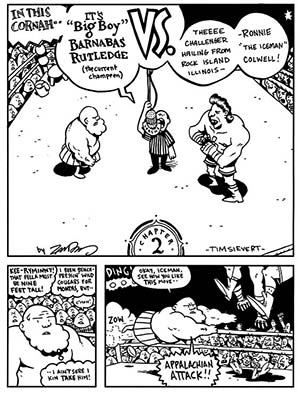
Another Cartoonist Parlour Game I forgot to mention in my earlier post on the subject is Character Battling. In this, two or more cartoonists create characters, and then they take turns drawing comics with the characters. Usually fighting.

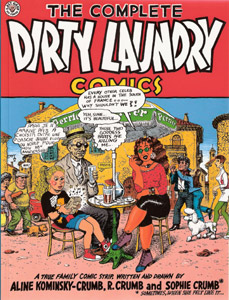
I don’t know what the history of this one would be… it is probably an instinctual activity of young cartoonists to collaborate with comics where each cartoonist draws their own character and they have them interact. In published comics, a notable example would be Robert and Aline Crumb’s ongoing semi-autobiographical Dirty Laundry Comics (previously to these, Bob Crumb had done a lot this activity with his brother Charles, as well).

Recently, the cartooning innovators at Big Time Attic have been doing comics in this fashion where they are very battle focused. Their innovation in this case is to have the conclusion of the battle determined by a coin-flip, rock-paper-scissors, or some other semi-random determining game (they go as far as to videotape the determining event and put it on you-tube, so you can experience the tension first hand). Here is the most recent example.