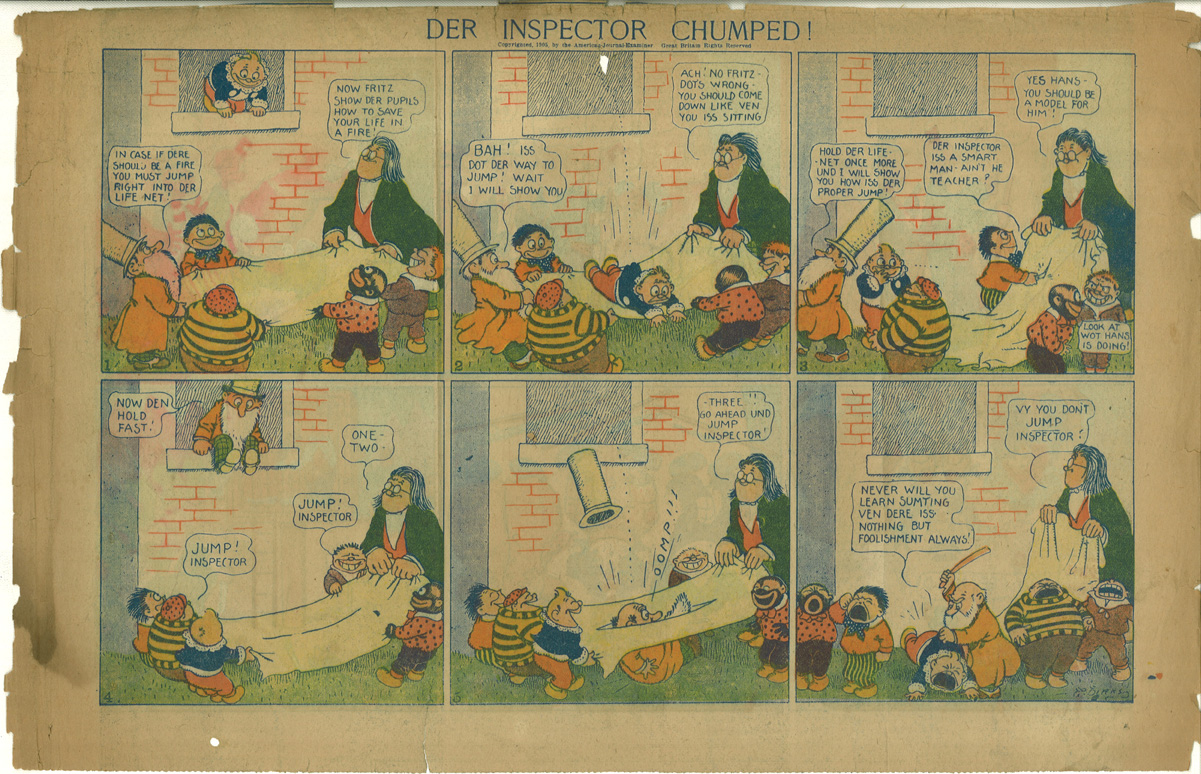
Crumbling Paper: The Katzenjammer Kids in Der Inspector Chumped! (1903) by Rudolph Dirks (strip #1)

A Katzenjammer Kids strip from 1903 by Rudolph Dirks. Click the image below to read the strip. The coloring on a lot of these early strips is pretty interesting. A lot of time they have areas of the line art appear in a solid color, rather than just leaving it black… note how the line art for the bricks in this strip is red and the other line work is blue. Note also you can see Happy Hooligan soaking through from the other side of the page. Click the below image to view the entire strip.


Here’s what Don Markstein’s Toonopedia has to say about the Katzenjammers.

I’ll have more Katzenjammer Kids cartoons coming in the near future.

Bill Blackbeard’s Grand Scheme for the Herriman Reprints

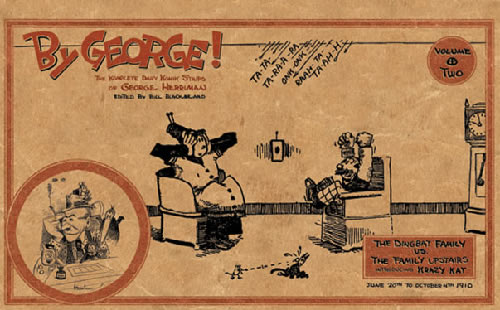
Going through some old email, I ran across this old post from comics historian Bill Blackbeard to the Yahoo PlatinumAgeComics group that I had missed previously… in it he deliniates his grand scheme for his George Herriman reprint projects. Here’s what he said (circa April 29, 2004… so some of this may have changed):

By George. the Komplete Daily Komic Strips of George Herriman, edited by the undersigned, is indeed up for sale at Andy Feigery’s Spec Productions, retailing at $24.95. It’s a whopper of a book, the extreme outsize dictated by the need to properly showcase the original daily strip episodes so that all of Herriman’s often miniscule (and very funny) detail can be seen clearly. The three complete strtps included are Herriman’s first newspaper dailies: Mr Proones, Baron Mooch, and Gooseberry Sprigg, the Duck Duke (where we get our first look at Coconino County). 54 gigantic pages on antique cream stock to catch the cachet of old newsprint, opening from the top to facilitate reading ease. The next volume, due in three months, will carry a large swatch of The Dingbat Family/The FamilyUpstairs daily, which followed these first three titles into newsprint, again to be printed in large format to catch the details previously crammed into (and sometimes lost) in the shabbily printed Hyperion title. More volumes will cover the rest of the Dingbat epic and — of course — all of the initial years of the Krazy and Ignatz opus underfoot, then include all of Stumble Inn and Baron Bean, to turn to the last great daily, Krazy Kat itself. (Fantagraphics will, as planned, publish all of the kolor kat tabs from 1935 thru 1944 in a fine series of volumes, and will fit the Sunday Stumble Inn pp into odd corners of these titles. The handful of little known dailies not yet mentioned will be included in the Spec volumes over time (such as Mary’s Home From College and the like). Herriman’s illustrations for the archy & mehitable titles will not, however, be included, since they are an integral part of the don marquis text, which is widely available in several editions in the used book market. The KK dailies now being published in odd volumes and magazines roundabout will all be eventually included in the By George series, needless to say. Introductions and commentary to upcoming volumes will be solicited from our old pal Allen Sundry, so get ready to get into line, guys and gals! (This includes our own too long Eclipsed kat, of course.)

Best,
Bill B.

Currently the first five volumes of By George! The Komplete Daily Komics of George Herriman are currently available from Spec Productions, as are Krazy & Ignatz volumes 1-8 from Fantagraphics. This takes the Sunday Kat reprints up to 1940, if you include the previous series from Eclipse (that Fantagraphics will be reprinting the contents of with additional material (Stumble Inn) after the next 2 volumes are complete).

THE CARTOON CRYPT: Monkey of the Week, March 30, 2007: Simon the Monk in Monkeydoodle

THE CARTOON CRYPT

Whoops, I thought I had published this on March 30th, but I just saved it… here it is now. Our monkey of the week for two weeks ago!

I knew nothing about this cartoon previous to finding it on youtube, but finding it is like finding lost pirate treasure. It is awfully bizarre and interesting, and it stars a monkey in a fez, so it is right up my alley. It’s pretty amazingly raunchy for the time period, too… monkey boobies are prominently featured. It’s made by Les Elton and is from 1931.

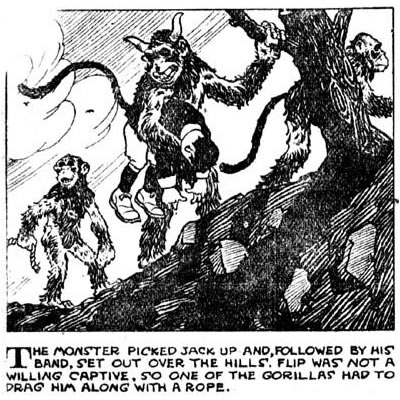
I’ve never heard of Mr. Elton previous to this cartoon. Googling for Mr. Elton brought me some interesting information about him at the Stripper’s Guide blog, and, even better, more lost pirate treasure… a series of pretty amazing comic strips he did called “Jack Daw’s Adventures.” Comics historian Allan Holtz, who is the guy who does the wonderful Stripper’s Guide blog, believes this strip is the very first syndicated adventure strip featuring a continuing character… and he has reprinted about 50 of them on his site. A panel sample can be seen below.

Crumbling Paper: Happy Hooligan Strips by Frederick Opper circa 1903 and 1904 (strips #1 and #2)

Here’s a Happy Hooligan strip by Frederick Opper from 1904… click the image to see the strip.

Pictured in the panel above we see (besides the gemsbock), from left to right, Happy Hooligan and his brothers Montmorency and Gloomy Gus.

In spite of being easily one of the most popular comic strips of its era, Happy Hooligan, as far as I know, has only been the subject of ONE modern reprint book.

As usual, esteemed comics historian Bill Blackbeard was the culprit… he had a Happy Hooligan volume in his wonderful Hyperion Library of Classic American Comic Strips book series from 1977.

I don’t believe Opper’s other strips (which were also quite popular… Alphonse and Gaston, and And Her Name Was Maud) have had modern reprint books at all. There were only books that came out while the strips were still running.

This is a pretty awful oversight, as besides his massive popularity in the early part of the last centrury, Opper is a very funny cartoonist and excellent artist. You can also see samples of Opper’s work in some comics history overviews, like The Smithsonian Collection of Newspaper Comics and 100 Years of Comic Strips (both wonderful books also edited by Blackbeard).

How funny is Opper? Happy Hooligan wears a tin can on his head for a hat. A tin can! That, my friend, is genius.

Here’s a fragment of the February 15th, 1903 Happy Hooligan strip… click the image to view it.

Here’s what Don Markstein’s Toonopedia has to say about Happy Hooligan.

I’ll be reprinting some more Opper stuff that I’ve scanned in the coming weeks, among other things.

Crumbling Paper: Billy Bounce and The Teasers (1903) (strip #1)

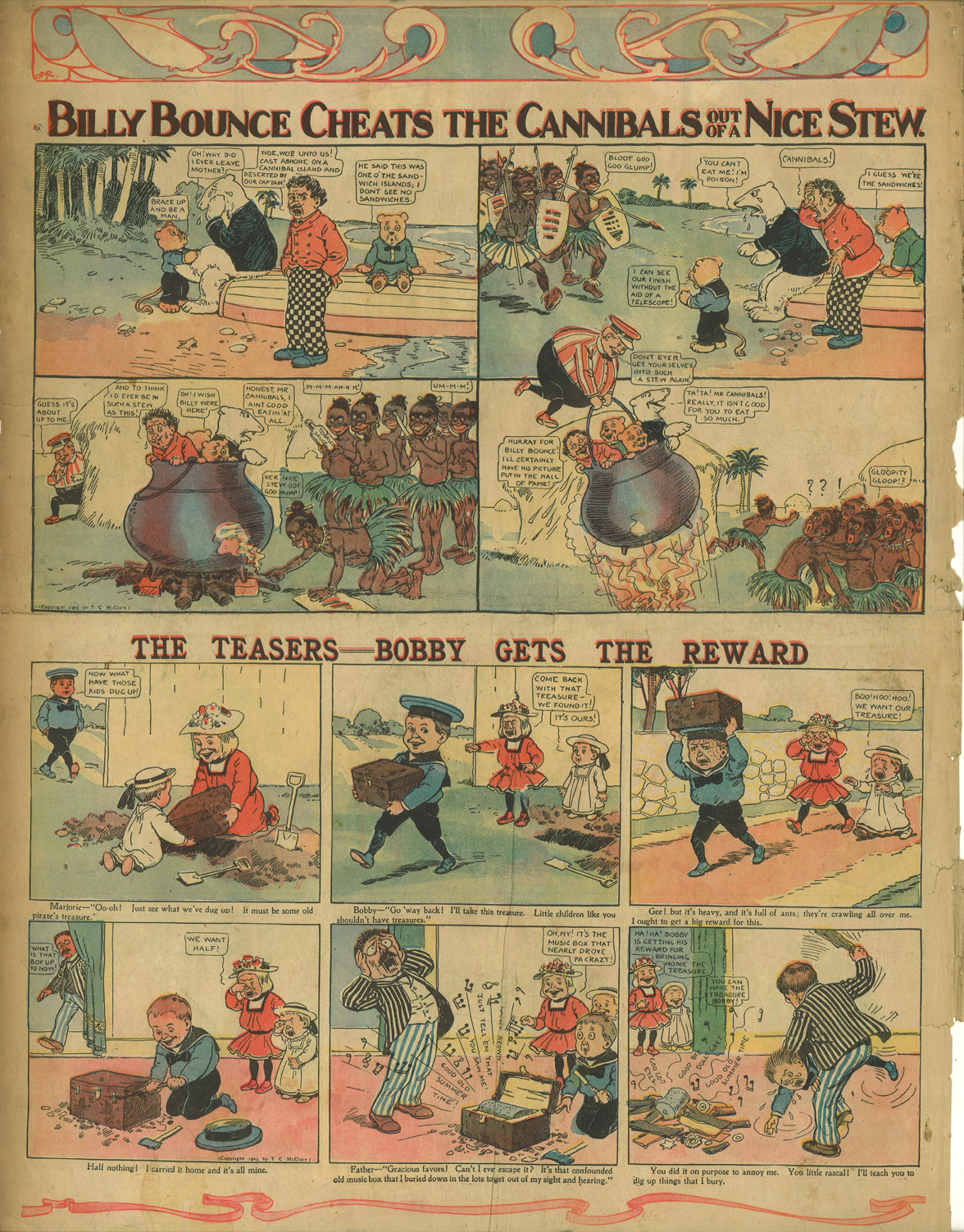
Here’s the other side of the Uncle Pike page I posted the other day. Today we have Billy Bounce in “Billy Bounce Cheats the Cannibals Out of a Nice Stew” and The Teasers in “Bobby Gets the Reward.” Billy Bounce is a bizarre character… he’s a big, fat, bouncing ball-boy. His cast is very odd too… I have another one of these I will be posting sooner or later.

Billy was created by W.W. Denslow of Wizard of Oz book illustration fame, which makes a whole lot of sense looking at the characters. It was taken over in 1902 by C.W. Kahles, who did this one (Kahles later went on to create Hairbreadth Harry). This one is by Kahles… it’s a fun, weird strip.

The Teasers is also by Kahles… the main character looks pretty much like Billy Bounce after losing weight, although I actually hadn’t made the connection that the two were drawn by the same person until checking the Ohio State Cartoon Research Library site. Neither strip has a signature, and they have a stylistically very different feel to them. The Teasers uses a bizarre technique of using both word balloons and printed copy below the panels to convey dialogue.

Click the image below to see the full page (warning: contains offensive racial depictions, as is often the case with old comics).

Crumbling Paper: George Carlson’s Pie-Faced Prince of Pretzleberg (strip #1)

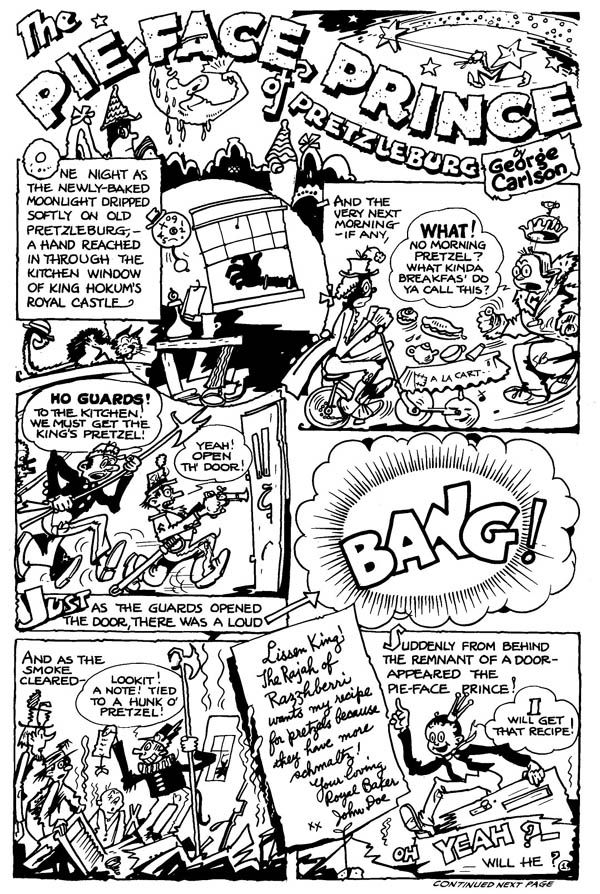
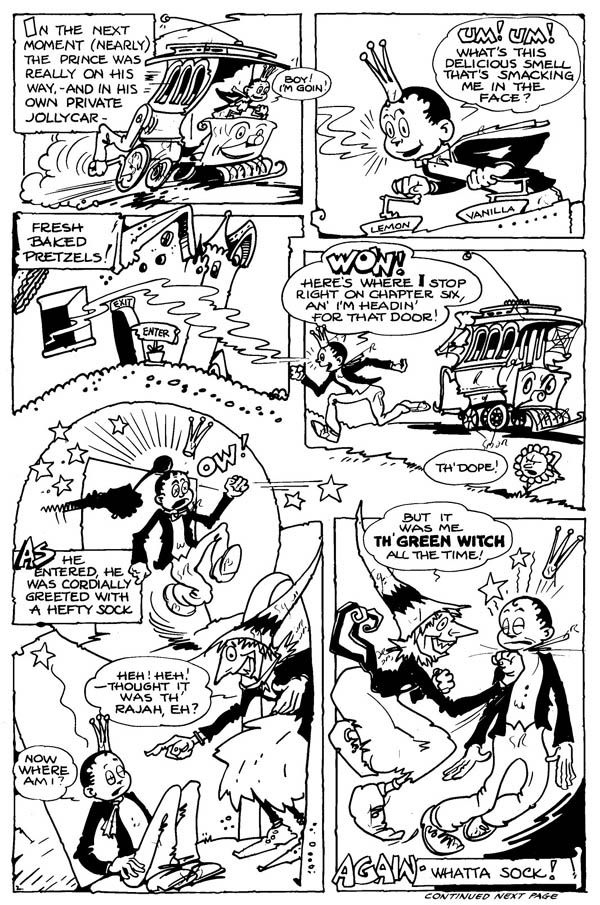
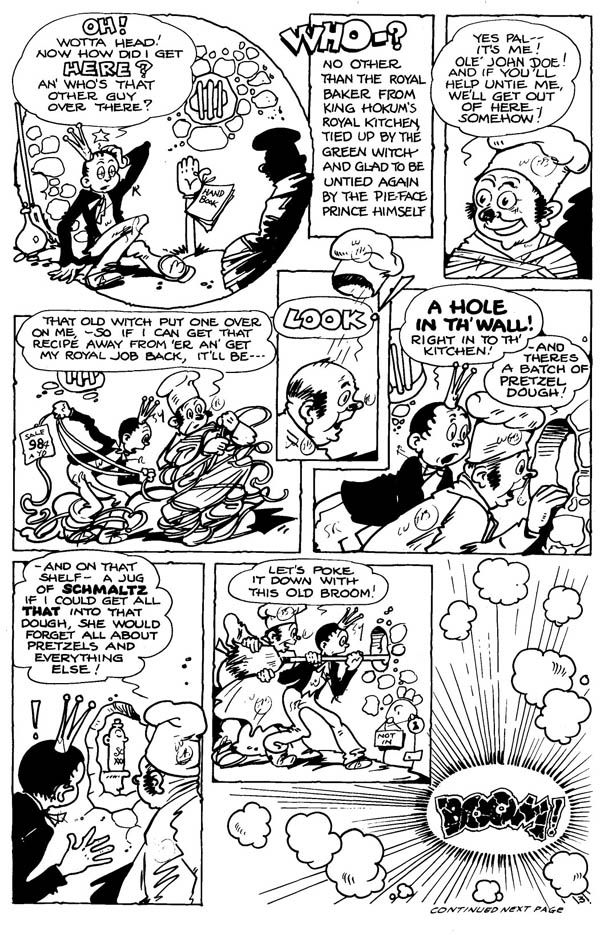
I found these nice scans of an installment of George Carlson’s Pie-Face Prince of Pretzleberg from an unknown issue of Jingle Jangle Tales a while ago on Ebay. These are black and white scans from the original art (which is what they were selling). The pages are gorgeously and inventively designed and illustrated, as always seems to have been the case with Carlson. Fun and crazy stories as well.

I wish someone would reprint his entire output, I’d love to read it all. You can see some more of Mr. Carlson’s work in The Smithsonian Book of Comic-Book Comics, if you can find a copy… he also did a Learn to Draw Comics book that I’ve been meaning to order for ages. It is a cheap Dover reprint, only $5.95, which has gotta be a steal.

Sooner or later, I plan to get around to scanning the issues of Jingle Jangle that I’ve acquired.

Page 1
Page 2
Page 3
Page 4

Crumbling Paper: Uncle Pike by A.D. Reed circa 1903 (and some miscellaneous gags) (strip #1)

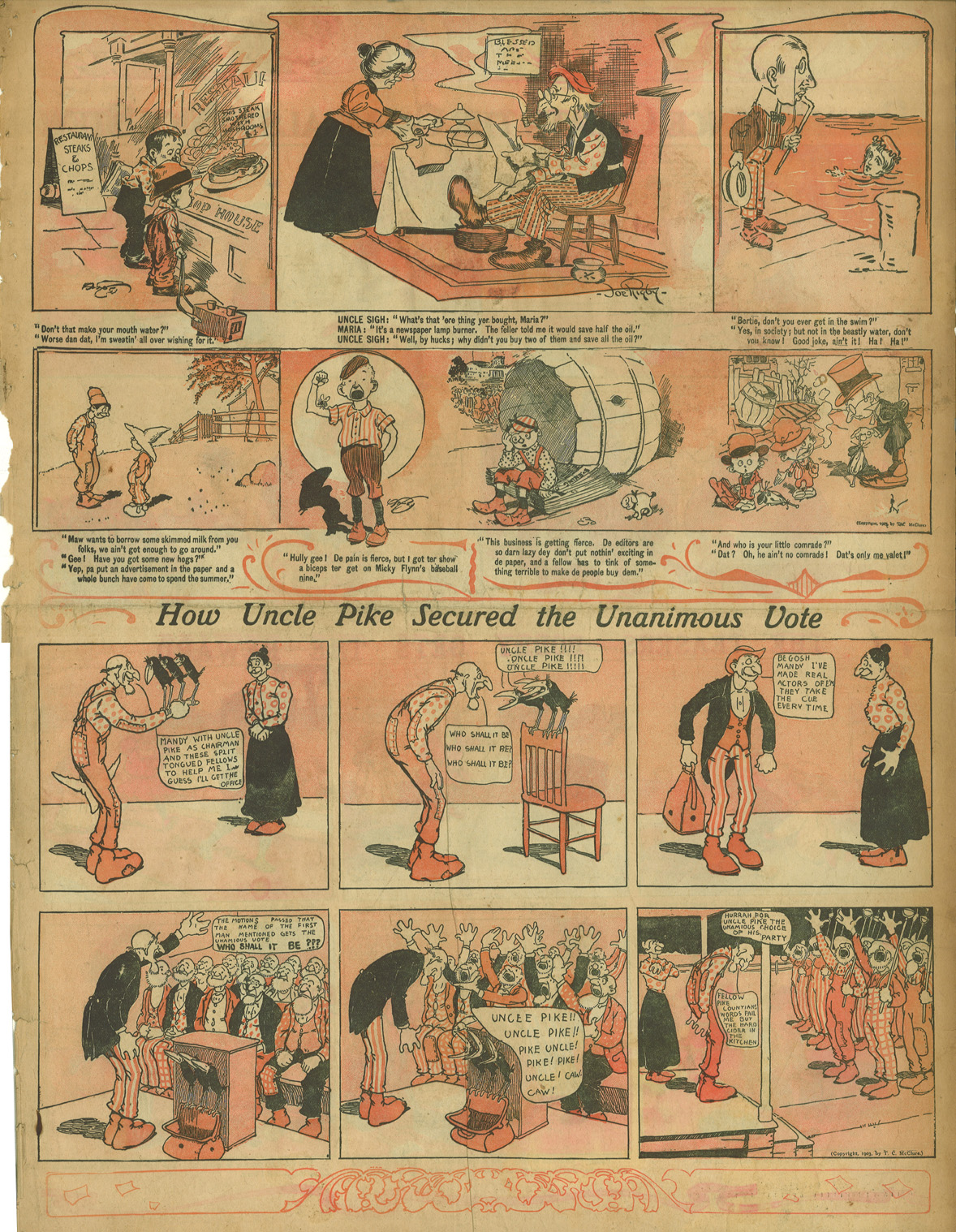
Here’s another huge old Sunday scan for you. There are two strips on this page from 1903… the top is

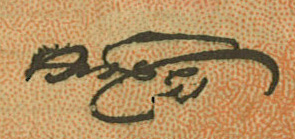
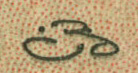
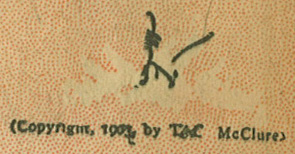
a series of one panel gags by a number of different cartoonists. The only legible signature is that of “Joe Rigby” in the second panel. Here are close ups of the other ones… can anyone out there identify these cartoonists?


From panel 1.

UPDATE: Cole Johnson identified the artist of panel 1 as Carl Anderson.


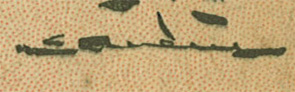
From panel 3. Looks like “Sanders.”

UPDATE: Cole Johnson identified the artist of panel 3 as C.R.McAuley.

Panel 4 is unsigned.


From panel 5.

UPDATE: Cole Johnson identified the artist of panel 5 as Carl Anderson (as with panel 1).


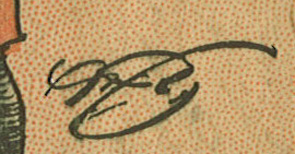
From panel 6.

UPDATE: Cole Johnson speculates that panel 6 may be by George Herriman… definitely looks like a likely possibility to me as well, although that signature-like scribble may indicate otherwise.


From panel 7. The art looks a bit like James Swinnerton, but I doubt it is him.

UPDATE: Cole Johnson identifies this panel as being by William Marriner.

The second strip is “How Uncle Pike Secured the Unanimous Vote” by A.D. Reed. According to the Ohio State collection, Uncle Pike ran from 1902 to 1905.

I’m not sure what paper these are from… the Ohio State copies are from The Philadelphia Press, and the copyright on these is McClure. Click on the below image to view the strip.

700 Things, and the Vigilant Hound

I previously mentioned the 700 Hobo project I participated in, which had cartoonists from around the world draw interpretations of 700 hobos named by hilarious author John Hodgman.

Since I wrote, the project has expanded in new directions… all the hobos were completed some time ago. Now the group that brought you 700 hobos has conceived of 700 things to draw 700 of… aka the 700 Things Project. These will be tackled gradually, but the first nine are already active.

700 Things
700 Hoboes (give or take 100)
700 Zombies
700 Pirates
700 Underwear Clad Vigilante Mutants
700 Bunnies
700 Unicorns
700 Robots
700 Clowns
700 Knights in Splendiferous Armor

Here’s how it works… at the start of a project people submit names to a list on flickr until it becomes a list of 700 items in the subject. Then they are put into an “official list” and people start drawing. Different peoples’ interpretations of the same character are fine. Once you’ve drawn your illustration, you post it to Flickr and tag it appropriately to be added to the appropriate group. Some of the organizers are also going to do a 700 things website which will eventually suck in the info from Flickr and organize it.

I’m going to try to eventually do at least one drawing for each group as they appear… I’ll post the results here.

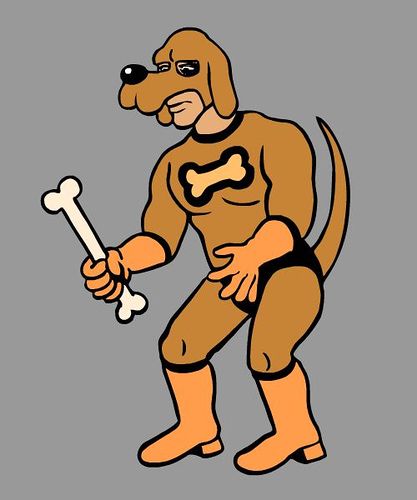
Here’s my first drawing for the 700 Underwear Clad Vigilante Mutants (i.e. superheroes) Project… #21 The Vigilant Hound.

THE VIGILANT HOUND

Real Name: Richard Bruce

Identity/Class: Human

Gender: Male

Age: 26

Occupation: Playboy

Group Membership: The Kennel Club

Enemies: The Flea, Bulldog, Hell Hound, The Mail Man, Fire Hydrant

Aliases: The Mutt of Mystery

Base of Operations: New York, NY

First Appearance: Sideshows of Justice #26

Powers/Abilities: Enhanced sense of smell, counter-balancing tail, The Big Bone of Justice.

History: The Vigilant Hound designed his costume with the intent of striking fear into the heart of evildoers… unfortunately his childhood fear of hound dogs proved not to be as universal a fear as he had hoped.

Nevertheless, he had chosen the life of a crime fighter, and fight crime he would. Besides, the tailor who custom designed it for him wouldn’t take returns.

Armed with his big bone of justice, and aided by his 8-year old sidekick Puppy, he mostly strikes laughter into the guts of criminals everywhere. However, in his view, a laughing criminal is almost as vulnerable as a fearful one. At least, that’s what he tells himself.

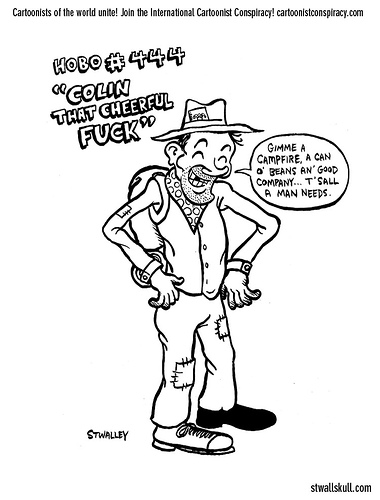
Also, in my 700 Hobos post I mentioned above showing off my artwork I did for that project, realized I forgot to include one of my hobos… here he is…

Colin that Cheerful Fuck

This cheerful rapscallion is widely hated for his positive attitude in the face of extreme hardship and poverty.

Race and Ethnicity in the Early Comics

I recently scanned a bunch of huge ancient pages of ancient Sunday newspaper comics that will be appearing here… here is the first one.

I chose the most obviously offensive one to share first, as there is a lot to offend in these comics, so I figured I’d address this at the outset.

As with a huge amount of cartoons from the early part of the last century, it features tasteless racial depictions. As a person living in the modern world looking at old comics and cartoons, it is pretty mind blowing just how racist many early comics are. As these unfortunate and ignorant caricatures can sometimes taint the reading experience, I think it is worthwhile to analyze where these cartoonists were coming from with this stuff a bit.

First of all, I think it is worth observing that although the depictions are shallow caricatures, they are rarely hateful. For me, this is the largest part of the reason that I usually have no problem stomaching this stuff… sure the depictions are based on ignorant generalizations, but the motivation is almost always to amuse rather than to spread hatred.

Second of all, my impression from reading stuff from early in the last century, I don’t think that most people even had heard of the concept of racism. Race and ethnicity was not only viewed as a ripe source of humor… it was one of the most popular sources of humor.

Today’s newspaper comics (which I should note are incredibly tame in comparison to the early comics in almost every way imaginable) have their genres… domestic humor, office humor, funny animals, etc. If you were to divide up the major genres of the early (pre-1920) comics, it would have been something like racial and ethnic humor, devil children humor, unstable marriage humor, dim-witted woman humor, homelessness and poverty humor, violence and misfortune humor, and wacky surrealism.

Clearly, the world has utterly changed.

I find these comics to be important historical documents, depicting views of people from another world, and they are frequently hilarious and entertaining. I’m able to forgive, if not overlook, their often dim-witted views on race and ethnicity (not to mention women, the homeless, etc, etc, etc.).

I hope in viewing these old comics you will be able to enjoy them in spite of their shortcomings in these areas… there are many wonders to be found in the old comics, but they definitely aren’t for everyone. If you find these comics offensive, you are well justified, and if such is the case I encourage you not to view them.

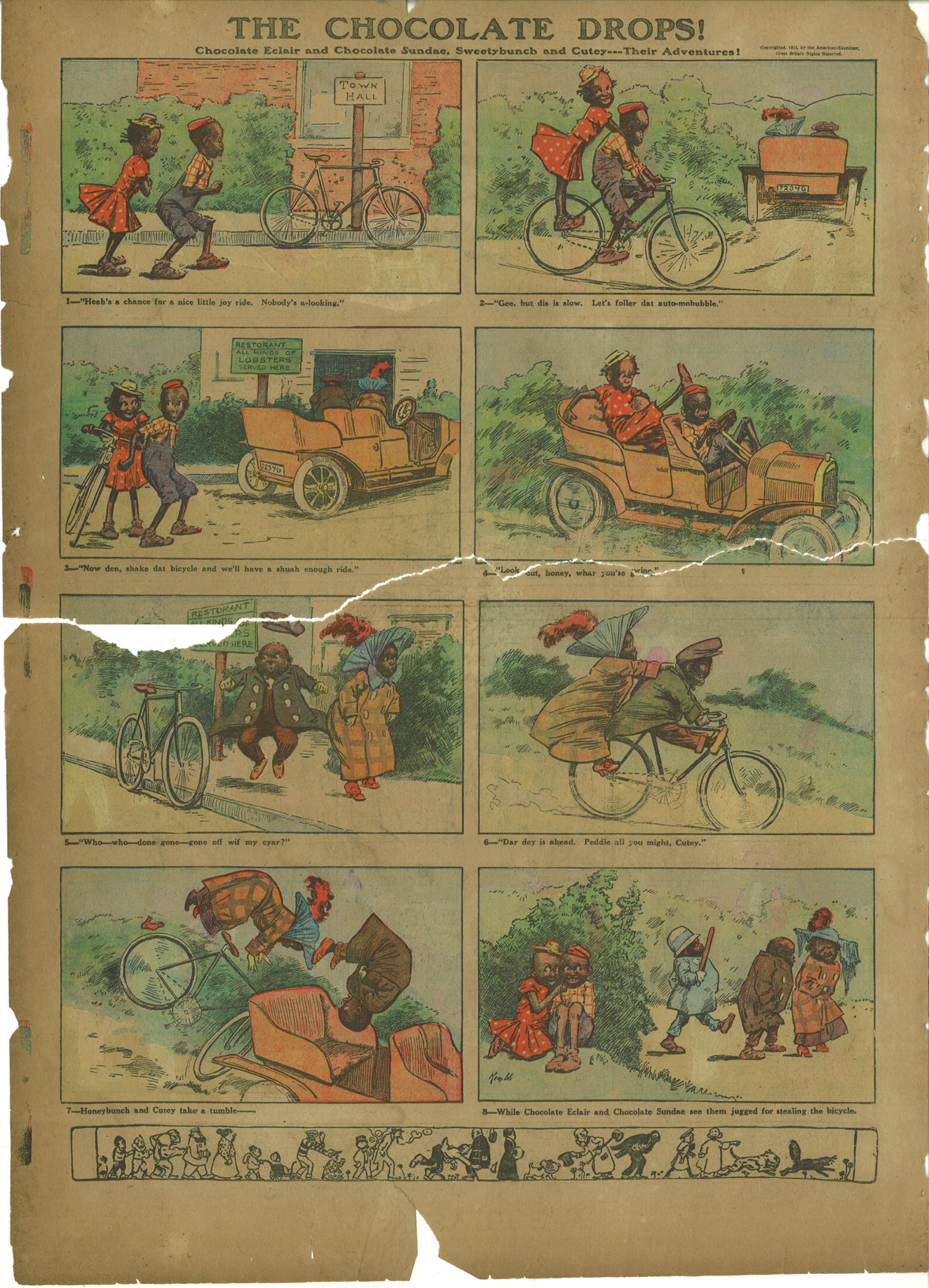
So that all said, here are deeply offensive Chocolate Drops, by E. W. Kemble, circa July 23, 1911 from the American Examiner.

Oy. If you can handle this one, I doubt you’ll have any problem with the rest of the scans.
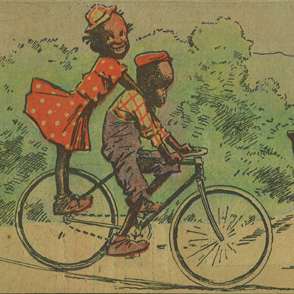
I can’t imagine a strip in a modern paper depicting young kids stealing a car for a joyride and laughing when they get some adults arrested, can you? Anyone who says the past was a more innocent time is talking out of their ass.

Crumbling Paper: Gluyas Williams Circa 1927 Strip #26

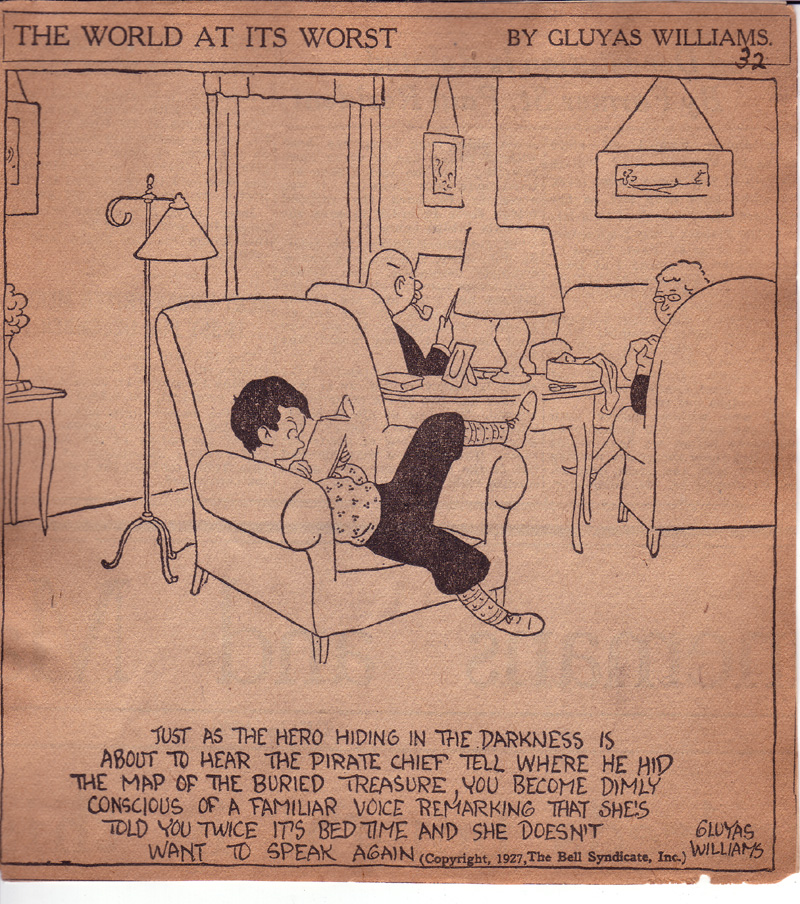
This is the last item in a series of scans of 1927 strips from cartoonist Gluyas Williams. Thanks again to Zander Cannon for passing these great strips my way. I’m donating the scans to gluyaswilliams.com to give them a more fitting home on the web… hopefully their collection of strips will continue to expand. Click on the image below for the full strip.

You can see some more great stuff by Gluyas Williams at gluyaswilliams.com, at The Stripper’s Guide, and at Barnacle Press.